

Table of Contents
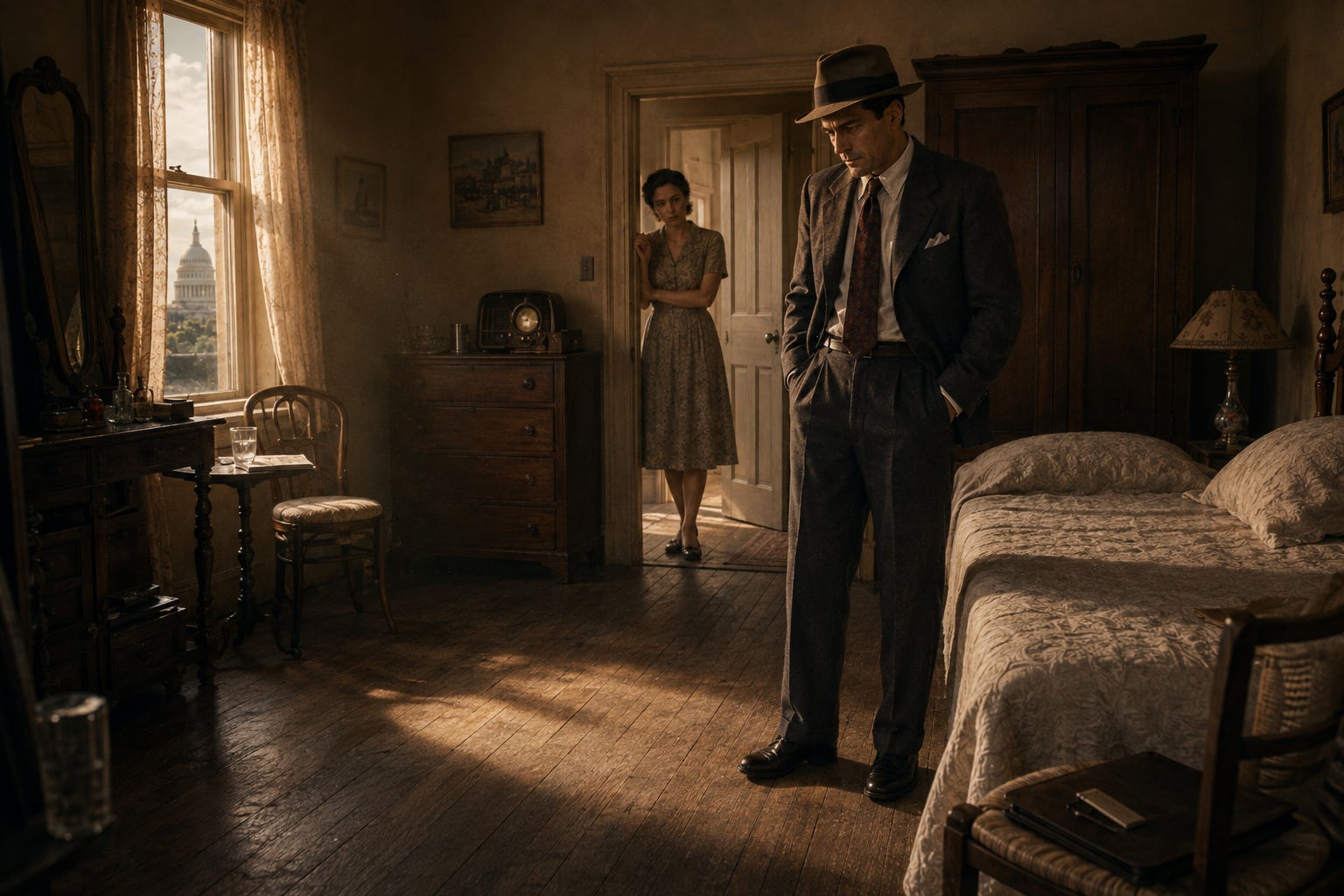
Columbia Heights, Washington, D.C.
Azalea Court Boarding House
Monday, August 6th, 1945
Sam Mercer returned the brown envelope to Marian Keene, containing her letter of appointment to the Bureau of Naval Personnel and reporting instructions. “Thank you. Your cooperation is most appreciated, and again I’m sorry for the intrusion.”
She shrugged, her lips curved. “It’s really fine, detective—glad to help. I haven’t even unpacked—I only started today.”
A slight woman in a cotton dress, her dark hair pinned back. A mark on her nose suggested she wore spectacles for work.
Mercer glanced at his watch. The hour hand closed in on six in the evening. His stomach rumbled. He skipped breakfast and forgot lunch. “I’ll be as quick as I can.”
Besides Mercer’s property case, the room held two suitcases, a hatbox, and a portable typewriter—things belonging to Keene, that he could and must ignore. That left the permanent furniture and fittings to check.
“I’m just going to have a look around.” He paused. “Police work is a lot like housekeeping. Well, most of the time.”
Mercer did not lie. The rest involved flying fists and lead. Keene watched, her eyes following him, not out of malice but interest.
He pulled the drawers first: the dresser, then the matching dressing table. All emptied by Benson, but he removed them and checked the undersides. Nothing pinned or taped out of sight. Inside the matched wardrobe, he breathed in mothballs. His pocket flashlight searched the corners and the back of the fitted shelves on the right.
From across the hall, a radio played. A bright commercial jingle snapped to a close, replaced by a news bulletin. Someone turned the volume up a notch.
“…Hiroshima, an important Japanese Army base.”
A chair and a table stood by the window. Mercer looked under both and found nothing.
The announcer’s voice continued reading the White House statement. “…It is an atomic bomb. It is a harnessing of the basic power of the universe.”
Mercer lifted the mattress and the wire frame, exposing the floor, bare but for a fine covering of dust—a word that once described the infinitesimal. Then they split the atom. Mercer resolved to give up. He shifted his weight, lowering the bed into place, but something caught his attention—more movement than noise. Mercer shone the light on the spot where his polished and oft-repaired shoe sat—a loose floorboard.
He reached into his pants pocket for his penknife and used the blade to lift it. Fine scratches showed. Somebody else before him must have done something similar.
A short length of wood, a foot or so long, popped out. A pipe with a joint explained why. Next to it lay a tobacco tin.

“A hiding place?” Keene asked.
Mercer spread a sheet of clean wrapping paper from his property case across the bed. “So it seems.”
He put pencil to notebook and noted the time and place, then sketched the loose board’s location.
Using his handkerchief, he lifted the metal box from the space, set it down, and popped the lid with the tip of his penknife.
He tilted the contents onto the paper.
Then he listed each item in order—a New York driver’s licence. The title read Evelyn Shaw. Twice now. Mercer’s Law of Coincidences: One happens. Two deserve attention. Three probably aren’t. A Social Security card, too. An electricity bill and a rent receipt from a Manhattan address for Shaw. Her real name?
A small cardboard wallet held a photograph. A pair of teenage girls, very much alike, an older and younger sister. Which of them might now call herself Schmidt, Hoffman, or Shaw? He frowned, certain only one of them did.
The last item lay beneath: a gold locket—dainty and plain. He picked it up with his handkerchief, just in case, and used the tip of his penknife to flick the picture box open.
Two images under glass on either side: a baby and a girl of perhaps four or five. Mercer’s pencil scratched again: The same person, or siblings? He added a note: Mrs Benson and Miss Keene both witnessed the discovery.
“Is everything all right?” Mrs Benson asked.
“Yes. I just have to make sure I log what I’ve found in case it proves important later. It often doesn’t, but…”
“Good housekeeping?” Keene said.
He slipped each item into separate manila envelopes and wrapped the tin in clean paper, placing these into his property case. “Indeed. Thank you both, again.” He collected his hat and bid his goodbyes.
Next — Chapter 3: Purpose
Ok, you've got me!
The mystery becomes more intriguing. I like how you combined the historicity of the news bulletin with the fictional mystery.