

Table of Contents
Tenth Precinct Station, 750 Park Road NW, Washington, D.C.
Monday, August 6th, 1945
Detective Sam Mercer set his tan fedora over his mop of brown hair. The barber’s shop would have to wait. With neither the change to spare nor much time, he draped his jacket over one arm and left the Washington Metropolitan Police Department’s Tenth Precinct. The seasonal heat demanded it. The close air carried the fumes of motor traffic and hot pavement.
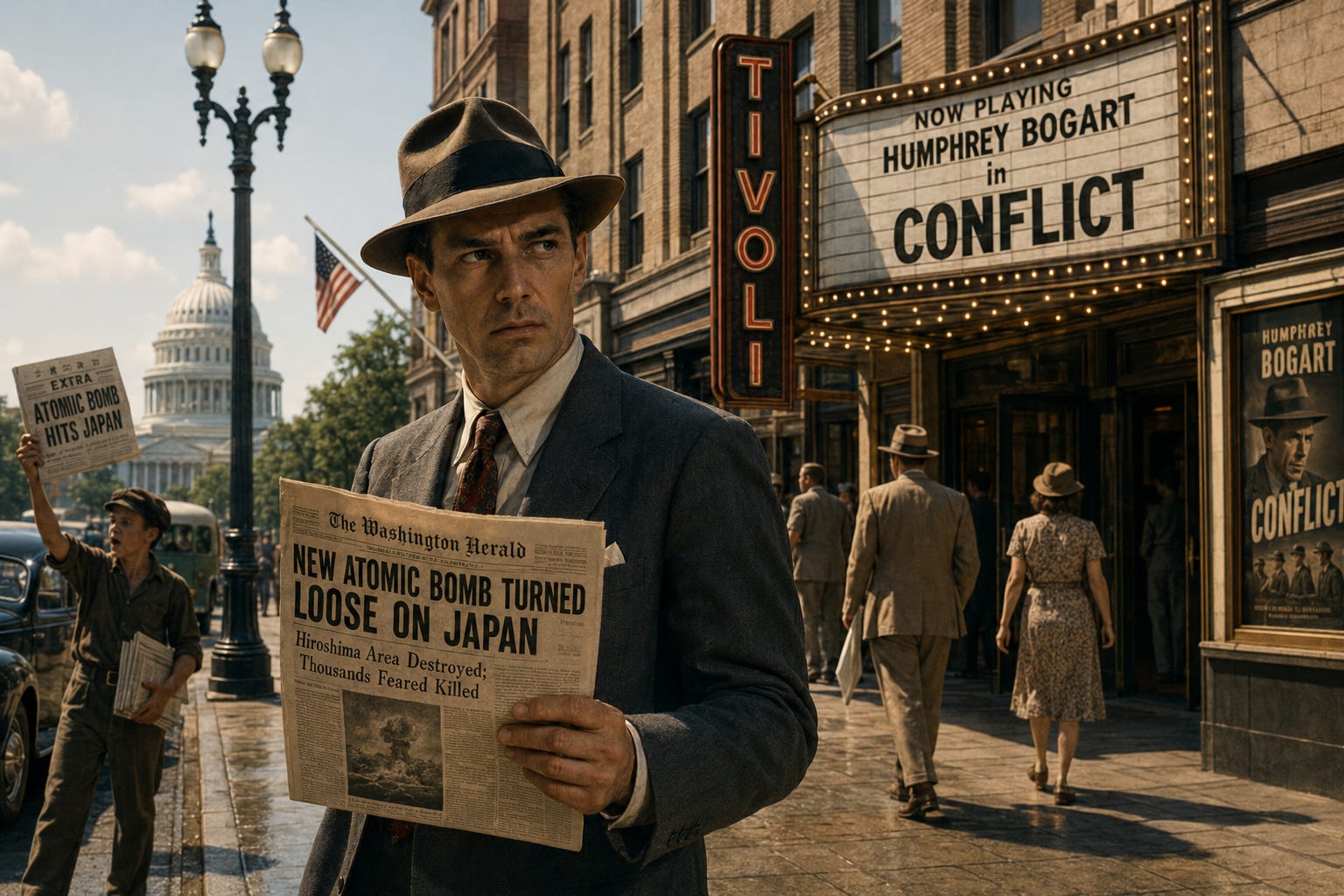
From the station, Mercer followed Park Road toward Fourteenth Street. Apartment houses rose above shaded pavements. He passed a pharmacy, a grocer’s striped awning, and women carrying parcels against their hips—a different world. A newsboy shouted, his voice hoarse. “Extr’eee! Read-all-about-it! Super bomb smashes Japs.”
Mercer flipped a nickel to the lad, waved off the change, and absorbed the Times-Herald headline.
NEW ATOMIC BOMB TURNED LOOSE ON JAPAN.
‘Equal to 20,000 Tons of TNT’, said the subhead.
Mercer let out a quiet whistle. Hiroshima Hit. Army Base Target for Single Super-Weapon.
He struggled with the numbers. Not the math—a B-17 flew with around twenty-five hundred pounds of explosives, most of the time. Translated into a conventional raid, that made for ten thousand heavy bombers, each carrying maybe half a dozen regular bombs.
All that power carried by one weapon on a single plane.
On a crowded D.C. sidewalk, standing in his neat civilian suit, Mercer felt a sudden, cold shudder—a quiet mixture of dread and awe.
Ahead, the Tivoli filled the corner—pale tan stucco, red tiles, and those big arched windows. A poster for the new Bogart picture, Conflict, hung on the wall. Mercer stepped into the cinema’s air-conditioned lobby. He took a breath, removed his hat, and wiped his brow. To call a murder, conflict, seemed narrow when a single weapon could level a city.
Azalea Court lay beyond the noise of the main thoroughfare, on a narrower street where brick houses sat shoulder to shoulder behind shallow steps. Open double-hung sashes greeted the summer air, flowery drapes tugging in the breeze. Mrs Benson’s Boarding House prepared Mercer for its proprietor—an older woman in a dress cut from the same cheerful pattern, which tented her matronly figure.
She welcomed him inside. Mercer noted the communal telephone; the common parlour stood empty. The rest of the property appeared divided into rental rooms. The hallway ended in a door marked private.
“It’s good of you to come, young man.”
Mrs Benson did not mean that. Her posture and tone said otherwise—a woman waiting for attention to her demands. Mercer, as a junior detective, would turn thirty next year. In truth, he felt time passing him by.
He flicked open his notebook and read his spidery handwriting. “You called on the first of the month?”
“Yes. I became concerned.”
Mrs Benson gave a tired shrug. “Miss Schmidt told me her work sometimes would take her out of town, that her employer required her to travel. She often worked late. So many girls do these days. Keeping odd hours.”
Mercer heard the tone shift from frustration to disapproval, the sigh from annoyance to resignation. He checked his notes.
“You did not see her during July?”
Benson stiffened. “She paid for the entire month. Besides, she told me on the Fourth that she might not be back and that I should not worry. At the time, I understood that meant a night or two away. Later I thought I perhaps misunderstood—misheard her. It isn’t my place to pry.”
“You concluded this must be a longer trip?”
“Yes. I admit after a couple of weeks I did begin to wonder, but…” Mrs Benson paused, as if embarrassed, or at least uncertain what to say.
“Miss Schmidt being paid until the month-end?”
She nodded. Mercer added a note with his pencil. “You told Sergeant Cole at the Tenth Precinct that you expected her to return?”
“Yes. Miss Schmidt kept herself and her room tidy.”
“You called on Saturday, however?”
Benson flushed, and not from the heat. “I have a business to run. I can’t let a bed stand empty. Someone came looking for accommodation.”
“And you boxed up Miss Schmidt’s belongings?”
“Of course, and I would have held on to them, just in case she returned—well, for a while at least. I don’t make a habit of prying. You understand. I found the… documents and things.”
Mercer read his notes again. “Can I see them?”
“This way, young man.”
Mrs Benson walked to the end of the hall. Mercer followed. Inside lay a kitchen and sitting room—the servants’ pantry in the house’s grander days.
She gestured to a cardboard box in one corner. “Those are her belongings, clothes, and two suitcases. So many outfits—I packed them too. Don’t you think that’s odd?”
“That she went on a trip without her luggage?” Mercer understood her point.
Benson picked up another bag. “She left this, and I almost always saw her with it.” She placed the large leather purse on the table. “I put… everything I mentioned to the desk sergeant in here.”
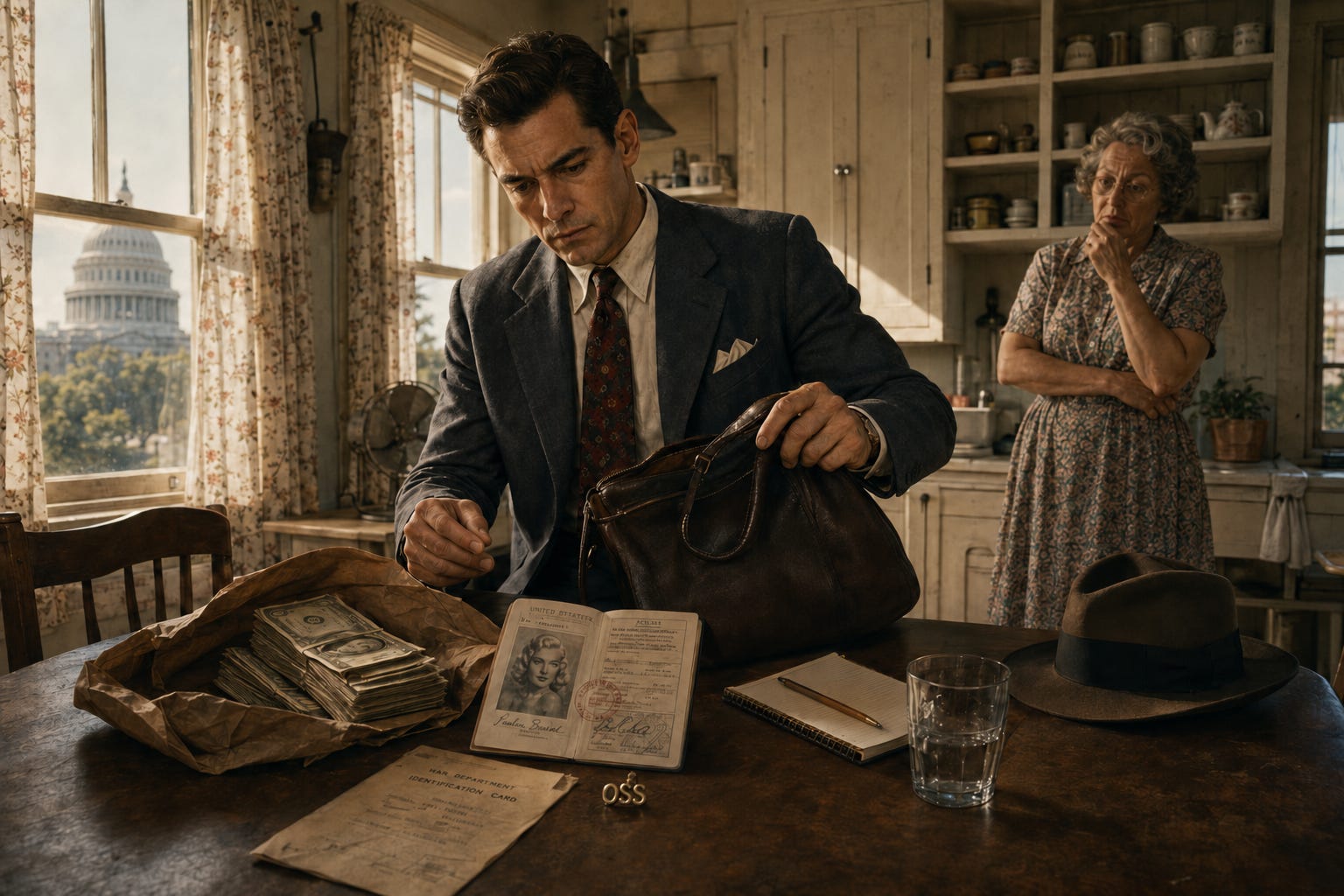
Mercer glanced inside. The label read Bonwit Teller, New York. Besides the usual collection of items he recognised—a hairbrush, a powder compact, and a nail-care set—he noticed a brown paper bag folded over. He withdrew it. Money, large bills. Mercer counted around five hundred dollars: over two months’ wages for a junior detective. It did not look like the kind of dough a bank would deal out to a customer withdrawing funds. Too well used.
Still, not a sum to abandon without a good reason. He appreciated Mrs Benson’s concern, and why Ray Cole chose to pass the case to him. He added moral character to her qualities.
She stared with an animated expression.
He opened a second paper-bagged bundle—a soft green cover—a U.S. passport. A gold eagle spread its wings. Liesel Schmidt. A black-and-white photograph and a written physical description: blonde hair and blue eyes. With it, a District of Columbia operator’s permit for a motor vehicle, issued to Evelyn Shaw of Connecticut Avenue. The typed details matched Miss Schmidt’s, but for the name.
He showed the picture to Mrs Benson. “Is this her? Your tenant?”
“Oh, yes. It is a reasonable likeness. Not always so, not with those tiny photographs, but that’s her alright. I’m good with faces, I have to be, in my business.”
“May I have a glass of water, please?” Mercer asked—not only because the heat made him thirsty, but because helping him in this simple way distracted her while he worked.
Inside a wallet, Mercer found a cardstock identification marked Office of Strategic Services, Greta Hoffman. It bore an embossed U.S. seal. A small metal pin engraved with OSS. He frowned; this felt off. He needed to check, but his gut said forgery—made to impress and trying too hard.
Mercer’s law of the grift: when something looks too good to be true, it’s almost always a con.
He copied the details: three names, all supported by official-looking documents.
Mrs Benson returned with a glass of water. Mercer thanked her and took a gulp.
“Do you think she’s really a spy?” Her eyes flickered to the headline in Mercer’s paper.
Mercer set the tumbler down. “We’re still at war, and this is D.C.”
“But you couldn’t tell me?”
Mercer grinned. “We’ll have every reason to search her room. I am sorry—I’m sure that’s inconvenient for you and your new tenant—but if you found these things in plain sight, I have my doubts we will discover a hidden transmitter under the bed.”
“I came across the paper bags in a drawer.” Mrs Benson paused. “Under her smalls.”
Mercer looked at the money and the documents again. “There’s another, more mundane explanation. I’ll need to find out where she worked and make a few calls, but I’ve dealt with this kind of thing before.”
“You have?”
“Yes. Con artists, grifters—they use fake identities, pretend to be people they aren’t, as many costumes as they can. The cash looks tired too. Been through lots of hands.”
“Dirty money?”
“In a literal sense, and no doubt in the metaphorical one too.” Mercer smiled. “You did the right thing to call.”
Loving the atmosphere here. Placing Mercer's investigation right alongside that Hiroshima headline instantly cranks up the tension and makes 1945 DC feel lived-in and gritty.
The "tired cash" clue and the Schmidt/Shaw/Hoffman puzzle were handled beautifully; that's exactly the kind of procedural detail that makes this work. And the shift from spy-thriller territory into con-artist territory caught me completely off guard, in the best way. Really eager to see where Mercer heads next!
C.J., I am always down for a good noir detective story, and this one has started out to deliver just that. I'm along for the ride, wherever this investigation takes Mercer.